





Cold email personalization explains why your offer belongs in this recipient’s inbox. A first-name field changes the greeting. Useful research changes the reason for the email: the company fits, the person has a relevant role, and the message offers a sensible next step.
Start with a public fact, connect it to your offer, then ask one question. For example, an onboarding responsibility in a job listing supports an onboarding-related conversation. It does not support a claim that the team is struggling.
What makes a personalized cold email relevant?
Use this chain: observable fact → commercial relevance → useful ask. Keep a source URL and the date you checked it outside the email. The reader needs enough context to understand your reason for writing, without a list of everything you found about them.
The examples below are illustrative drafts for fictional situations, not emails sent to actual prospects or measured campaign results. Replace bracketed fields and verify each premise before using a message. The sales prospect research checklist shows how to collect that evidence.
1. A hiring signal for an onboarding service
Source fact: A company’s own careers page lists an open customer-success role with responsibility for onboarding.
Why it matters: Your service helps teams document onboarding handoffs. The job description gives you a specific workflow to discuss.
Weak draft: “Congrats on your incredible growth! You must be struggling to onboard all those new customers.”
A more useful message:
Hi [first name],

Your customer-success job description includes owning onboarding handoffs. We help software teams document those handoffs so the process is easier to share with new hires.

Would an example handoff checklist be useful?

[your name]
What to leave out: The listing does not establish growth, hiring urgency, customer volume or a broken process. Do not add those claims.
2. An integration that fits the published stack
Source fact: The prospect’s help center explains how customers connect its product to Salesforce.
Why it matters: You build an integration that checks sync errors between the two products. Reference the documented connection, not an inferred internal CRM.
Weak draft: “I noticed you use Salesforce and probably lose hours fixing broken data.”
A more useful message:
Hi [first name],

Your help center documents the Salesforce connection for customers. We build a sync check that flags mismatched records between [product] and Salesforce.

Is customer integration reliability part of your remit? I can send the check’s scope if so.

[your name]
What to leave out: A customer-facing integration is not proof the company itself uses Salesforce, or that its integration is failing.
3. A public service promise and an operations offer
Source fact: A company’s service page describes scheduled maintenance across several locations.
Why it matters: Your service turns completed visits into client reports. Both the source fact and offer relate to the maintenance workflow.
Weak draft: “Your team seems busy. Our revolutionary software will save you 40% of your time.”
A more useful message:
Hi [first name],

Your service page covers scheduled maintenance across multiple locations. We help maintenance teams turn visit notes into a consistent report for each client.

Would you like to see the report format before discussing whether it fits your process?

[your name]
What to leave out: There is no evidence of team workload, a reporting problem or a percentage saving. Show your format rather than inventing a result.
4. Partner fit from a specific service offering
Source fact: An agency’s services page explicitly offers Shopify store builds.
Why it matters: You offer post-launch analytics configuration. That could complement its build service; it does not establish a missing capability.
Weak draft: “Your clients need better analytics. Let’s partner and double your revenue.”
A more useful message:
Hi [first name],

I saw Shopify builds listed among your agency’s services. We handle post-launch analytics configuration for store owners.

Do you ever bring in a partner for that work, or do you keep it in-house?

[your name]
What to leave out: Do not assume the agency lacks analytics expertise or that a partnership will increase revenue. Ask about the arrangement first.
5. No usable research: keep the message honest
Source fact: You can confirm company category and buyer role, but no recent event or operational detail.
Why it matters: A narrow role-and-offer match can still justify a question. If neither is established, skip the prospect rather than fill the opener with guesses.
Weak draft: “Loved your recent expansion! I’m sure your operations are getting complicated.”
A more useful message:
Hi [first name],

We help software operations teams document customer onboarding handoffs. Is that something you oversee at [company], or does it sit with another team?

[your name]
What to leave out: No expansion claim, invented compliment or assertion about the recipient’s workload. Use this only after checking the company and role fit.
AI cold email personalization: give the agent evidence
Ask the agent to write from a small, explicit set of facts. A long research summary can hide unsupported statements among good observations. Separate what the source says from your interpretation of it, and require a fallback when the evidence is missing.
Buyer role: [verified role]
Offer: [what we actually provide]
Public fact: [fact copied into research notes]
Source and checked date: [URL; date]
Relevance: [why this fact connects to the offer]

Write a short email with one useful question. Use only the supplied facts. Do not infer growth, dissatisfaction, budget or buying intent. If the fact is insufficient, flag that and use a role-based question or recommend skipping the contact.
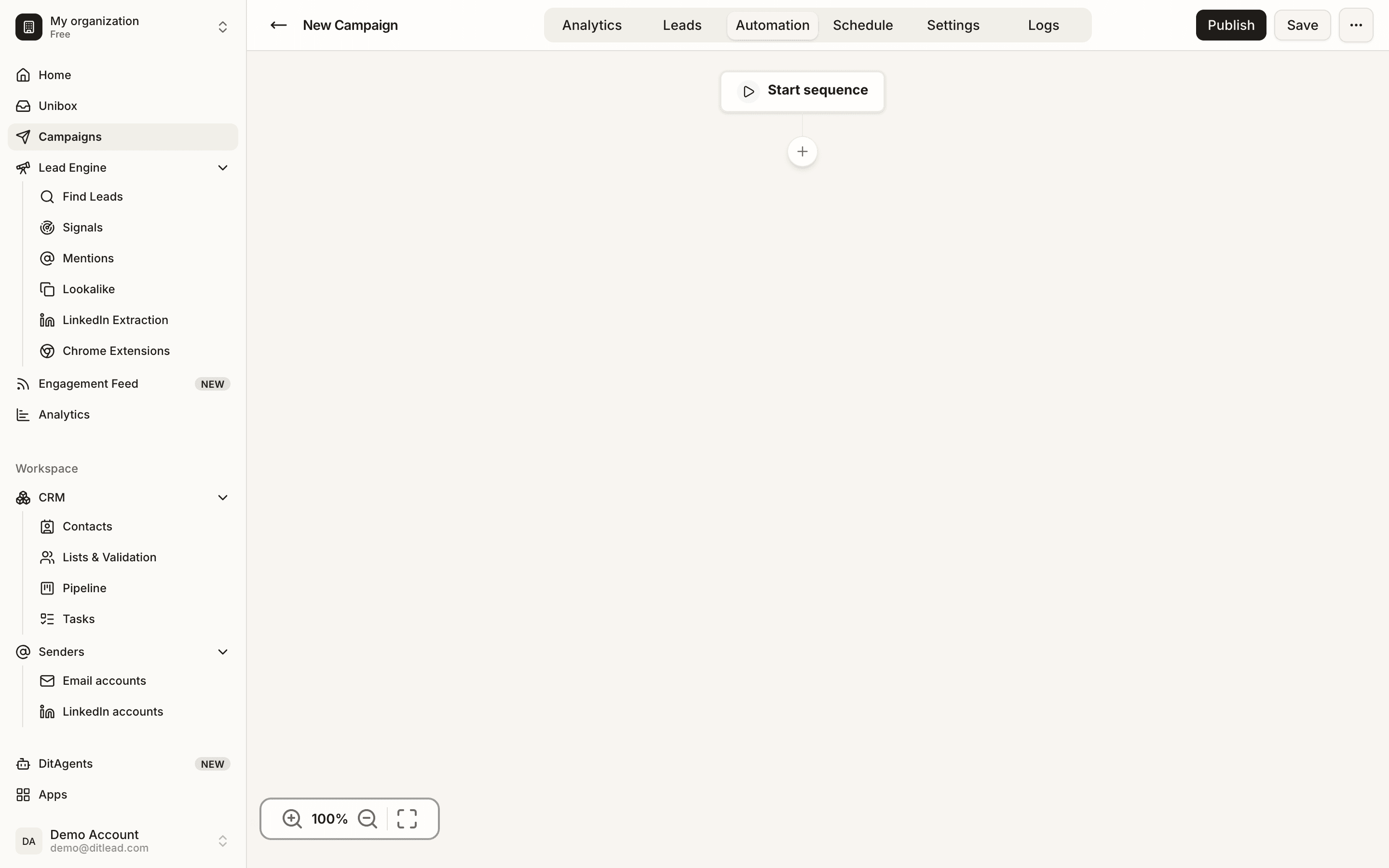
This is an illustrative drafting prompt you can adapt, not a claim that DitLead’s interface exposes these exact fields. DitLead AI personalization helps prepare individual messages. Review the factual premise and the offer before approving the copy.
Review personalized emails before sending
- Can you point to the source behind every specific claim?
- Does the buyer role fit, or are you asking the wrong person?
- Does the fact explain your offer’s relevance, rather than decorate the opener?
- Are you asking about a possible need instead of claiming to know it?
- Is the next step easy to answer without agreeing to a meeting immediately?
- Have you removed unverified results, guessed personal details and unresolved placeholders?
Read the email without its name and company fields. If its reasoning could fit every company in a broad database, narrow the audience or improve the research. More generated variations will not fix the same weak premise.
Carry the reason into the follow-up
A follow-up should add a useful detail: the checklist’s contents, an integration boundary or a question about ownership. Repeating the same compliment adds no information. Use our complete B2B cold email sequence examples for messages that build on one another and the follow-up cadence guide for timing and stop rules.
Start with your business and review the campaign
Auto Outreach uses your website to suggest audiences and campaigns, then researches prospects and prepares personalized emails. Review the segment, source-aware copy and follow-up sequence before launching. DitLead provides the mailboxes when Auto Outreach is enabled. Entering a website for a preview does not send emails.